Category: London History

Vauxhall Park model village gets suffragette makeover

Vauxhall Park model village gets suffragette makeover

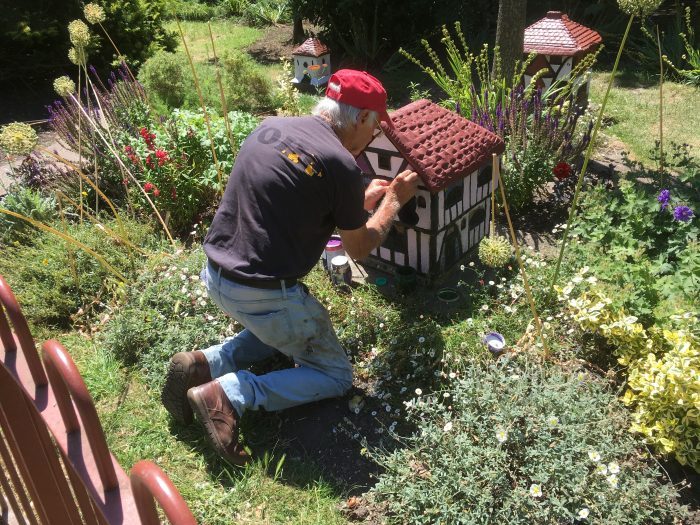
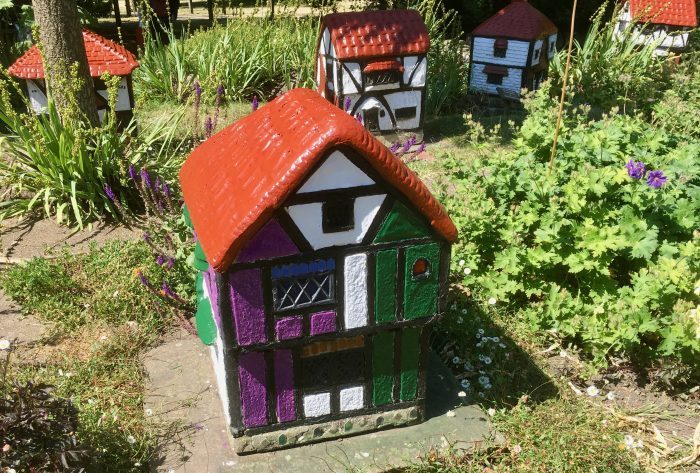
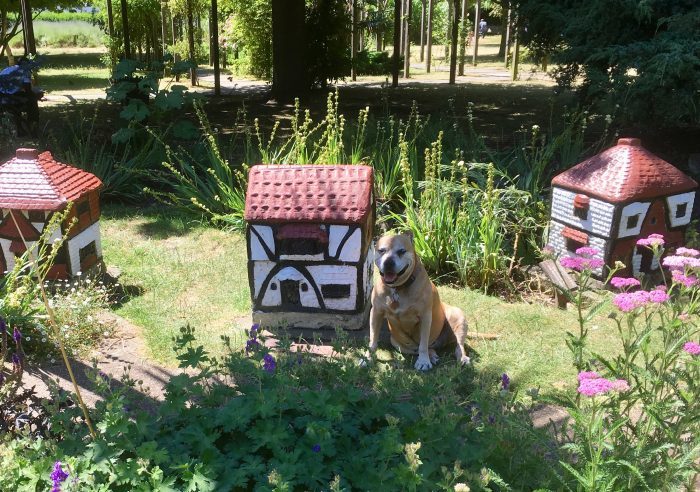
The tiny houses in the Rose Garden of Vauxhall Park are getting a makeover. Nobby, aided by his trusty dog Sandy, said he was giving the crofts and cottages a lick of paint in the suffragette colours of purple, green and white.

Why the suffragette colours? February of this year saw the 100th anniversary of the Representation of the People Act 1918 which enabled all men and some women over the age of 30 to vote for the first time and paved the way for universal suffrage 10 years later. Vauxhall Park has a connection.
Henry Fawcett (1833-1884) lived in a grand house on the site of the park. He was a Member of Parliament and was blinded at the age of 25 when shot by his father’s gun while the pair were out partridge shooting. Clearly a determined man he became Post Master General, started the parcel post and encouraged women to work at the Post Office.
Vauxhall parkIt was Fawcett’s wish to turn his garden into a communal park after his death. His wife, Millicent Fawcett, made it happen. Involved in the suffragette movement, she became president of the National Union of Woman’s Suffrage Societies in 1897. She also founded Newnham College Cambridge. Quite the power couple.

Talking with Nobby (or Nobby the Grab, to give him his full name) while he was taking a break from the painting and decorating, he told me the houses were made in 1948 by Edgar Wilson who sent a set of 30 to Melbourne, Australia by way of thanks for the food packages sent to us during the war. Next time you’re down under you can take a look.

There are also a couple of tiny detached houses in Brockwell Park near the clock tower.

As to the ones in Vauxhall, local hoodlums used to nick them until Nobby came up with the brilliant idea of filling them with sand and rocks so making them too heavy to shift. There’s only one original ‘Boat House’ left, the other two were made by the man himself. I should point out that Nobby does this on a purely volunteer basis, so if you see him about he deserves a big thank you.

Plastered at the Tate

Plastered at the Tate

In 1897 when the Tate Gallery (now Tate Britain) was nearing completion they got the plasterers in. And plasterers being plasterers, did what plasterers always do, they left a hidden note to be found by future generations. They got their wish.

This was placed here on the fourth of June 1897, Jubilee year, by the plasterers working on the job, hoping when this is found the Plasterers Association may be still flourishing. Please let us know in the Other World when you get this, so we can drink your health.

Signed: N. Gallop, F. Wilkins, H. Sainsbury, J. Chester, A. Pickernell (secretary)

The writer, perhaps the secretary, is hesitant to say whether plasterers fetch up in heaven or hell and opt for the ‘other world’ but given the lovely, humorous nature of the note I reckon it must be the former.

How much of their work remains, I have no idea, but I like to think that some of the UK’s greatest paintings hang in front of their smooth plaster work. This evening I plan to raise a glass and drink to the health of Messrs Gallop, Wilkins, Sainsbury, Chester and Pickernell.

Seventy years later

Just over seventy years after this note was written a callow youth visited the Tate for the first time. I was 16 years old and a pupil at a dreary boarding school in the Midlands. A school trip was arranged to visit the Tate Gallery in London. I didn’t have much interest in art and knew nothing about the artist whose exhibition we were going to see. All that mattered was escaping school and getting to London.

I’m not sure I’d ever seen pop art before, but I knew right away I loved it, particularly when we learnt that the artist, Eduardo Paolozzi, had made robots for the exhibition and at the last moment had carved them up and dumped them in a skip. When you’re a teenager at school in Rutland you feel like carving your life up and putting it in a skip. Here was something I could work with.

I think there were also some Warhol’s on display; possibly the Marylyn screen prints. It was all so new and so fresh, I couldn’t get enough of it. I now live around the corner from Tate Britain, but I’ll never forget my first visit.

Terror on the tube: Inspector Sands to the rescue

Terror on the tube: Inspector Sands to the rescue

I don’t want to alarm you but if while riding on the tube you hear an announcer say: “Would Inspector Sands report immediately to security” you may be part of an unfolding terror attack.

Apparently ‘Inspector Sands’ is the bland formulation used to alert staff, but not the public, that trouble might be brewing. What you don’t want in times of crisis is an announcer going into the ‘we’re all doomed’ routine, so the fictitious inspector fits the bill.

I know about this because my 14-year-old daughter told me and as far as can be established said 14-year-old has never been wrong about anything, ever.

Following some in depth google-research on my part it seems there might be something to it. Apparently, it originated in theatres and was used in case of fire. The name Sands being selected because they used sand to put out the fire.

And now you’re thinking: For heaven’s sake Jim, Inspector Sands because they use sand to put out the fire? Well please yourself, but the 14-year-old claims to have heard the announcement twice: once at Clapham South and once as Waterloo. She came through without a scratch.

It’s out of this world as Londoner beats the odds

It’s out of this world as Londoner beats the odds

We are just back from grabbing some summer sun in Florida. And if you’re thinking it’s all very well for some, but what on earth does this have to do with London? Then bear with me.

Our hotel, located on the ‘Space Coast’ was a forty-five-minute drive from the Kennedy Space Centre at Cape Canaveral. I could tell you what a fantastic museum it is, about how you can see the space shuttle, the Apollo rockets, the moon buggy, get to touch moon rock, but that stuff you can find on Trip Advisor.

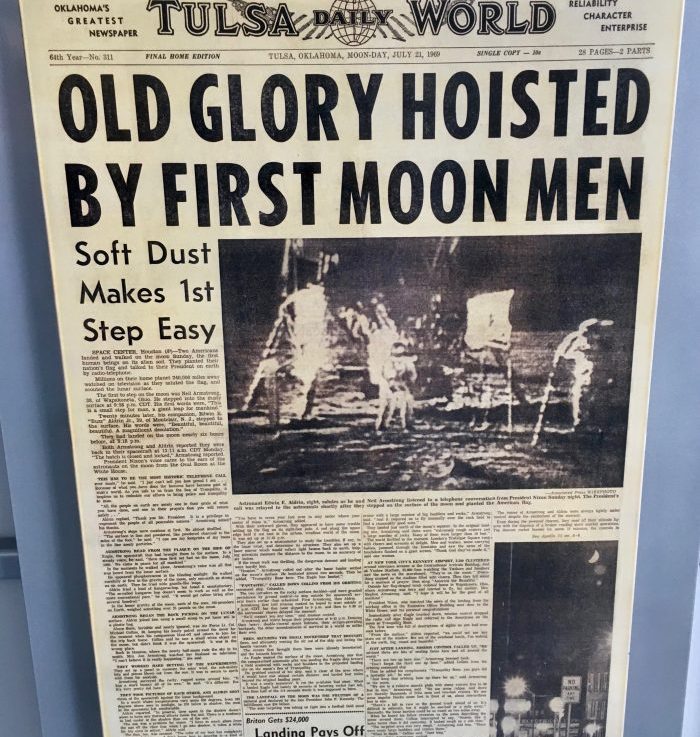
Walking by one of the Saturn rockets that sent Armstrong and Aldrin hurtling towards the moon there are a series of front pages capturing the excitement of the moment. A Saturn rocket may be an awe-inspiring sight, but a splash about the moon shot, for an old news hound such as myself, is impossible to resist.

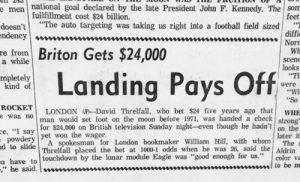
Working through the headlines: “First footprints on alien world” –  “Everything ‘Go’ Astronauts walk in lunar dust” – “Moon is magnificent desolation” –  “Old Glory hoisted by first moon men” my eye was caught by the headline: “Briton gets $24,000. Landing Pays off.” It was a short article at the foot of the Tulsa Daily Herald from 21st July 1969 and tells the story of David Thelfall who, in 1964, placed a bet of £10, that a man would set foot on the moon before 1971. At the time £10 was twice the weekly wage.

Threlfall later said: “In 1963 I heard President Kennedy make a speech in which he said there would be an American on the moon by the end of the decade. I thought if a bookmaker was prepared to offer reasonable odds it would be a common sense bet.”

Threlfall contacted William Hill and was duly offered the odds of a thousand to one. When Neil Armstrong took his ‘giant leap for mankind’ and the bet was won, the bookmaker presented Threlfall with a cheque for £10,000 live on TV from a London studio. In today’s money that’s around £150,000.

William Hill never revealed who their representative was who offered such absurd odds and as for Threlfall, he went out and bought an E-type Jag.