Clapton phones it in

Clapton phones it in

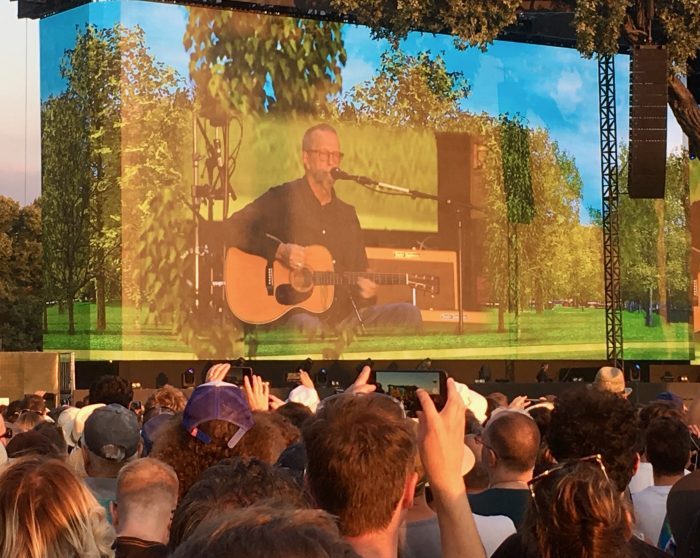
Last Sunday night (8.7.18) Eric Clapton played one of the British Summer Time gigs in Hyde Park. It was a glorious summer evening with the smell of hot-dogs, mixed with high notes of weed, wafting across the Royal Park. As the great sage of the blues guitar ambled on stage he muttered the immortal words: ‘It’s coming home’. Well if the footie’s coming home, the music had clearly missed its connection. The gig was as dull and dreary as cabbage. Perhaps the old boy’s past it.

OK, a little context is needed here. I’ve been a fan, off and on, for years. At school, my trigonometry text book (is trigonometry still a thing?) had the name of his band Cream written in psychedelic bubble letters on the cover.

Then in the 90s, friends of mine, the mighty Kick Horns, were Clapton’s brass section and I remember seeing some wonderful gigs at The Albert Hall.

Clapton made one album with Blind Faith, a band which featured one of my musical heroes Steve Winwood. Their only gig in London was at Hyde Park in 1969. As Winwood was also on the bill, I felt it safe to assume they would get together to thrill the crowds in 2018 as they had done all those years ago. Santana were also playing, and as Carlos and Steve have worked together it looked like a super celebrity mash-up of old mates was on the cards.

Earlier in the evening, both Winwood and Santana played blinding sets, but it was ‘Slowhand’ we had come to see. He started out quite low key with some mid-tempo blues, including Hoochie Coochie Man, and then became all but invisible with four acoustic songs including Layla and Tears in Heaven.

All of which may sound fine, but his heart wasn’t in it. Nobody was smiling on stage (not strictly true, the drummer seemed to have having a good time) there was no chemistry between the band members and Eric’s singing was at best perfunctory. Steve Winwood never showed up to partner with his old mate and it was left to Carlos Santana to spark things up when he came on to jam at the end.

Clapton didn’t even introduce his band which has the wonderful singer Paul Carrack in the ranks playing Hammond organ. If you don’t know the name, you’ll know the songs: How Long? The Living Years, Tempted. He has a fantastic soul voice but the only time we heard it was on the final song, which was the old Joe Cocker shout-a-long, ‘High time we went’.

Trust me, this is not the review I wanted to write, but for an audience to have a good time, the band need to have a good time. In truth Clapton barely turned up, went through the motions, and largely ignored the audience, some of whom started chanting ‘Football’s coming home’ during one of the more tedious segments.

For you completists out there, here’s the set list:

  • Somebody’s Knocking
  • Key to the highway
  • Hoochie Coochie Man
  • Got to get better in a little while
  • Drifitn’ Blues
  • Nobody knows you when you’re down and out
  • Layla
  • Tears in heaven
  • Lay down Sally
  • The Core
  • Cross Roads
  • Little Queen of Spades
  • Cocaine
  • High time we went (encore)
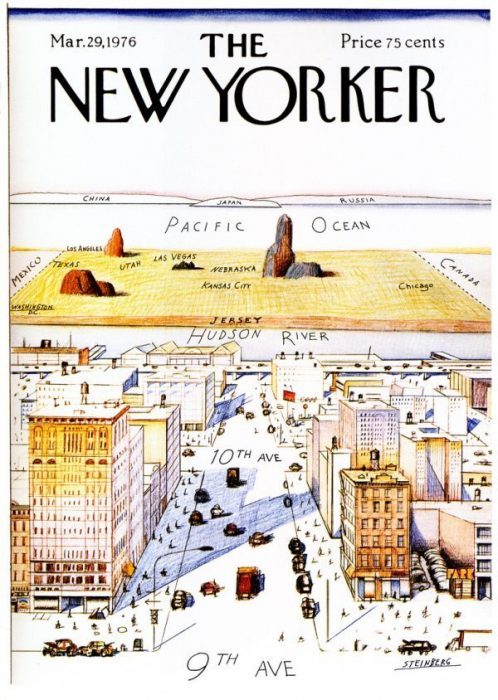
London & New York: Twin capitals of the world (2)

London & New York: Twin capitals of the world (2)

Hard times in the city

In my previous blog about the twin metropolitan giants, London and New York, I mentioned an essay by E.B. White called ‘Here is New York’. I imagine quite a few readers scratched their heads going E.B. who? Well, if you don’t recognise the name you may recognise the books. He wrote Charlotte’s Web and Stuart Little and if you haven’t read the books, I’m guessing you know the films.

White’s essay, written in 1949, is a love letter to his beloved New York (albeit one that carries warnings), which is written in the elegant, effortless prose style, that writers from that era perfected in columns for the New Yorker and elsewhere.

The article surfaced again after 9/11 because of a resonant paragraph towards the end of the piece about how vulnerable New York is to destruction. He says: ‘A single flight of planes no bigger than a wedge of geese can quickly end this island fantasy, burn the towers, crumble the bridges, turn the underground passages into lethal chambers and cremate the millions.’

While White could never have imagined the damage wrought by passenger planes used as weapons of war, he knew then as we know now that London and New York have a certain terrorist priority. He writes: ‘In the mind of whatever perverted dreamer might loose the lightning, New York must hold a steady, irresistible charm’.

On that terrible day I was at work in London, doing my job, which as improbable as it sounds, is to train people how to deal with crises. My wife, working on a national newspaper, texted me that a plane had flown into a building in New York. When I told the people in the room, they initially thought it was part of the training.

Thereafter, I remember walking home and watching television for hours trying to make sense of what was playing out live in front of our eyes. We saw the buildings come down and the crowds running from the swirling clouds of dust, ash and smoke; it was gripping and depressing in equal measure.

My birthday falls in September and that year (2001) my wife, had very kindly bought airline flights to New York as my present. Immediately after 9/11 all flights were cancelled, and passengers received a refund. Our tickets were dated about a week after the event and by then airlines, possibly feeling the pinch, said there were to be no more refunds. Do we go, or do we stay?

We discussed the pros and cons, and while, in the short term, the likelihood of another attack was vanishingly small, the thought of going on holiday to a place that had suffered so much death and destruction did seem a little odd. Frankly, I knew pretty quickly that we would go, but what I couldn’t have predicted was the reception we received.

After an uneventful flight (I like them that way) we checked into The W Hotel in Midtown. I don’t think I’ve ever been hugged by someone on reception when trying to check into a hotel. Although we hadn’t cancelled our booking there was a clear expectation that we would never show up. Locals seemed to think that tourists would never return, but there we were, being celebrated by New York’s hard bitten finest.

But of course, there were very few tourists, the city was eerily quiet. We paid a brief, respectful visit to the smoking ruins of the Twin Towers and walked for miles through deserted streets, occasionally coming upon small parks with pictures posted everywhere of the missing.

Two nights into our stay, Broadway opened its doors and of course we went to see a show. Later that evening we joined friends at a piano bar in Greenwich Village where we all belted out songs from Broadway shows. Drink was taken, the singing may have been terrible and some of the songs ridiculous, but it seemed like a small, splendid act of defiance.

The daughter of a family friend was studying in New York when the catastrophe happened, and her parents asked us to find her. We made contact and I remember seeing her sitting out front of her boarding house looking very small. She had been helping look after those who had been rescued and at 18 years old had found the experience overwhelming. We sought shelter in the best kind of New York sanctuary, a diner, where we ate eggs over easy with hash browns.

Then it was our turn. On the morning of 7th July 2005, exactly thirteen years ago today, terrorists struck London. Four suicide bombers with rucksacks packed with explosives travelled from Leeds to wreak havoc on the capital. Just before 9am three bombs exploded on the London Underground and a little later a fourth was detonated on a red London bus at Tavistock Square. Fifty-two people died, and more than 700 were injured.

Sitting at the desk I’m sitting at right now, I heard the news on the radio. My mobile and landline phone promptly stopped working but I managed to get an email through to my wife and received a reply to say she was OK. All emails then went down.

Ken Livingstone was Mayor of London at the time. To many he is now a somewhat discredited figure, but his rallying call to Londoners and his message to terrorists in the heat of the moment, was pitch perfect.

‘I know that you personally don’t fear giving your own life so you can take others, that’s why you are so dangerous. But I know what you do fear is that you will fail in your long-term objective to destroy our free society.
‘And I can show you why you will fail in days that follow. You will see. Look at our airports look at our railway stations look at our seaports and even after your cowardly attack you will see people from Britain, people from around the world, will arrive in London to become Londoners and to fulfil their dreams and achieve their potential.
‘They chose to come to London like so many have come before, because they come to be free, they come to live the life they choose, they come to be themselves. They flee you because you tell them how they should live. And nothing you do, no matter how many you kill will stop that flight, to our cities where freedom reigns.’

Perhaps you think that overly romantic, just political hyperbole, because I’m not blind to the fact that even on a good day London can seem brutal, daunting, even frightening. But Livingstone was right, people come here from all over the world to fulfil their dreams: the musician from a little village in Northampton, which he can’t stand a moment longer, the artist from Poland, who seeks a broader canvas and the builder from Romania desperate to send money home to his family.

In towns and villages all over Britain, all over the world, people right this instant are planning to come to London to make a go of their life, to accept the capital’s tough love. Now there’s something.

Want to be welcomed as a local in a Suffolk village? It might take two generations to find acceptance. Want to be a Londoner? Great, then be one, right now, immediately. Say it out loud: ‘I’m a Londoner’. And if that doesn’t give you a little chill, then perhaps this town isn’t for you.
Shock poll predicts England win this Saturday

Shock poll predicts England win this Saturday

Following exhaustive polling in Vauxhall using the latest data gathering techniques, ‘A Little London Life’ can reveal that the citizens of London SW8 are (almost) unanimous in thinking that England will crush the Nordic menace this Saturday.

Actually, what happened was this, Rusty the mutt and I took a stroll around the neighbourhood and asked whether England would beat Sweden and what the score would be?

  • James said we’d win 1-0 with a header from Harry Kane
  • Zoe was confident we would win 2-0
  • Ossie went for a cautious 1-0 to Ingerlund
  • Kevin said it would be 2-0 to Sweden (Damn, Kevin which side are you on?)
  • Dan said he’d put money on England beating Sweden 2-1 (He was standing outside a betting shop)
  • Peter also thought 1-0 would seal it for us (Frankly, he didn’t sound convinced)
  • Anna from Brazil said England would win 2-1 on Saturday but Russia would win the cup! (Then she said something rather rude about Neymar in Portuguese)
  • Mira said it would be 1-1 but England would win on penalties (I’ll have a heart attack if that happens again)
  • At Max & Melia our local gift shop, Maxine thought it would be 2-0 to England and her assistant Angel went for a more cautious 1-0.

Finally, Rusty and I popped into Oval Eyes, where we met Andrea. She is Columbian and had watched the game with her English boyfriend, when we knocked her side out of the tournament. She said she was sad, but sportingly hoped England would beat Sweden and thought it would happen with penalties!

Those are the facts ladies & gentlemen, and you can’t argue with facts, the people of Lambeth have spoken.

Vauxhall space art launches this Saturday

Vauxhall space art launches this Saturday

This Saturday (7th July) is Art Night with exhibitions and installations stretching down the South Bank through Vauxhall and on to Nine Elms and Battersea. This year the festival is partnering with the Hayward Gallery, which has curated projects by twelve internationally renowned artists.

One of whom is Turkish born Halil Altındere whose exhibition, Space Refugee (2016–18), is at the British Interplanetary Society (BIS). Walking south from Vauxhall Cross you may have seen the large circular picture of an astronaut on the wall above the BIS sign. The portrait is of Syrian cosmonaut Muhammed Ahmed Faris, the first Arab and only Syrian ever to travel into space. He visited the Mir space station in 1987.

The artist traces Faris’ journey from Syrian national hero, to pariah of the brutal Assad regime who was forced into exile and now lives in Turkey. Watching the exhibition being assembled, the installation uses a statue of Faris along with memorabilia from his space mission together with found objects at the BIS. Right now, four days before opening, the installation seems to be creating the vibe of an old-fashioned space museum.

At the centre of the show is a video which features Faris talking about the difficulties he faced in Syria, how he became a refugee and whether he will ever return home. Fearful of the fate of all refugees he says: “I hope we can rebuild cities for them (refugees) in space, where there is freedom and dignity and where there is no tyranny, no injustice.” The video also includes interviews with NASA scientists and architects discussing the possibility of a refugee colony in space.

On the circular picture of Faris outside the BIS are the words: Occupy Mars. One of the curators explained that as Mars is owned by no one perhaps the refugees of the world might find a welcome there. A fanciful, but sweet idea living as they do in a ‘hostile environment’ where refugees are often just pawns in a political game.

Spaced

Now I’m fairly certain some of you will be asking: What the hell is the British Interplanetary Society? I’m here to help. It was founded in 1933 by a group of space flight enthusiasts who dreamed of using rocket propulsion to explore outer space. Today, they are essentially an aeronautic lobby group or think tank who encourage everyone to get spaced, which his handy as the clubbers over the road manage it most weekends.

British Interplanetary Society, 27-29 South Lambeth Road, London SW8 1SZ

The exhibition, Space Refugee (2016–18), will run for ten days.