
A bunch of musicians, not sure if that’s the right collective noun, who are also mates of mine have released a song called ‘Holy Joe’ to raise money for the homeless.
I wrote the lyrics and I’m hoping with a little arm twisting on my part you might be persuaded to open your purses and wallets and direct a bit of your hard earned in Joe’s direction. If you’d like to cut to the chase, skip the rest of the story, and hear the song just click here. That’s fine with me.
Just before coronavirus hit, I’d started writing songs with an old chum of mine. His name is Simon Webb. He’s conducted the Cats orchestra, was the musical director for The Who’s Tommy when it appeared in the West End, and scored and played the music for Sir Nicholas Hytner’s celebrated Royal National Theatre production of Henry V. On occasions he can be found playing keyboards in deafening rock bands.
For reasons best known to himself he said he fancied writing some songs with me. I sent him some lyrics which by my own admission were mostly terrible, but Holy Joe had something about it. It’s a simple song about a homeless man I’d seen drifting around the streets near where I live in London.
Here’s a snippet:
My name is Joe, Little Joe Monroe
No one asks, no one says hello
I’m just another drifter, just another drifter in the snow.
Simon wrote some beautiful music that perfectly complements the words and there we were with a lovely song, unsure what the hell to do with it.
It was staring us in the face for weeks, before we finally realised it would make a perfect Christmas song and a fine way to raise money for the Joes and Janes of this world who are destitute.
Time and talent
Because of the pandemic, musicians, actors, bar staff, waiters and in fact everybody involved in the night-time economy have had a dreadful year. Many are suffering right now, but only in extreme cases does their suffering match the suffering of those who live on the street.
Simon started putting together a pretty sophisticated demo of the song and sent it to the musicians he regularly uses for his projects. Despite some of them having a tough year, they all agreed to give their time and talent for free.
Lockdown meant they couldn’t all get together in a room to record the song, so they recorded their individual parts at home and sent their musical brilliance to Simon who wove the whole thing together like a wonderful musical tapestry.
It sounds like making the record that way is incredibly easy, but trust me it’s not. I got Simon to explain how it all works but he started talking about musical stems, digital audio workstations, deverb, gating and logic and frankly I got a little lost.
Donate and share
To finish, if you like the song please donate what you can and share the link with your friends on social media. Every penny will go to a homeless charity. Early in the new year we will divvy up and let everyone know where the money has been placed.
Please make a donation here: https://www.justgiving.com/crowdfunding/holyjoe
You can also listen on Spotify.
Want to know more about the band?
The Spiderhawks
Robert Hart is the singer. He is currently fronting Manfred Mann’s Earth Band and has toured with Bad Company and The Jones Gang, the group run by Faces tub thumper Kenney Jones.
Guitar player Jay Stapley’s credits include Roger Waters, Mike Oldfield, Scott Walker and Shakin’ Stevens, but I like him best because he played guitar on perhaps the finest British film: Withnail and I.
Drummer John Trotter sent his drum part all the way from Australia where he now lives. John has worked with Robbie Williams, Hot Chocolate, Cliff Richard, The Corrs, Georgie Fame, Ruby Turner, The Three Degrees, Boney M and The Platters.
Sax player Al Stewart has worked with Tom Robinson, Cliff Richard, George Michael and Bert Weedon (Google that name kids).
Pete Jagger played the harmonica. He’s a singer and guitar player who tours extensively playing his own brand of folk, blues and ragtime.
Steve Stapley and Lynda Hayes provided the backing vocals. Lynda has sung with Barry Manilow, Nik Kershaw, George Michael, Lloyd Cole and the Commotions, Meatloaf and many others. Steve is a gifted singer songwriter. He sang in the rock choir on Evita for the film and soundtrack album and has worked with Sir Tim Rice.
John Gordon played bass, is one of the funniest people on the planet, and has worked with Alan Price and Wanda Jackson among many others.
Please make a donation here: https://www.justgiving.com/crowdfunding/holyjoe



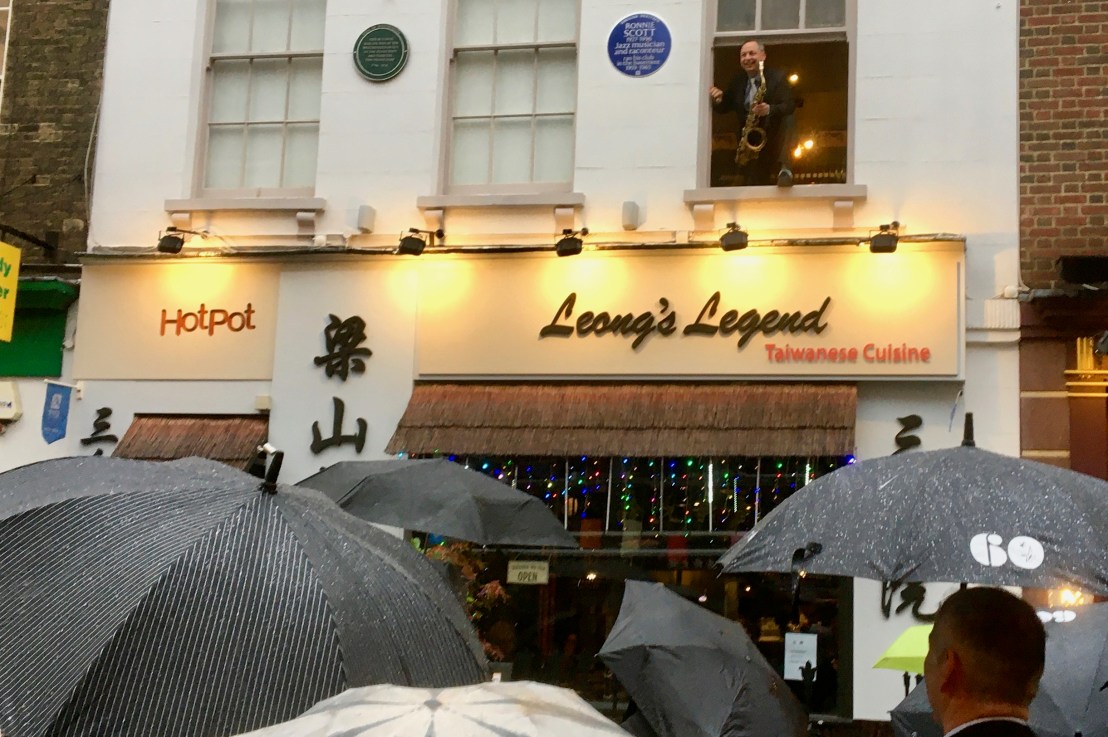
 It was bucketing down; more like an Asian monsoon than gentle British rain. Appropriate, I suppose, as there were a hundred of us gathered in Chinatown getting soaked. Suddenly a saxophonist stuck his head out of an upstairs window and started to play.
 Simon Cooke, the MD at the club, who’s a mate of mine said: “Ronnie Scott’s Jazz Club has led the way in British Jazz for 60 years through its innovative programming and championing of the music and musicians. An English Heritage Blue Plaque is a fine acknowledgement of the contribution that Ronnie Scott himself made to the British Jazz scene.” He also said a lot of stuff that was entirely unprintable.
 I should declare an interest here and that interest is I love jazz and have been going to the club since the late 70’s. In fact, I was there last night to see the mighty
  A Little London Life