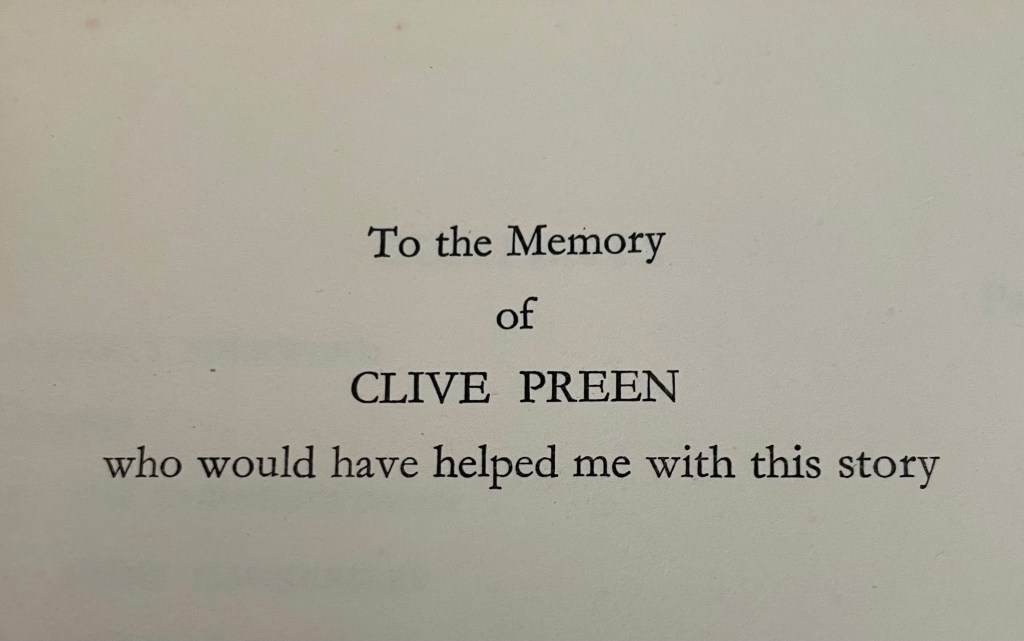
Dedication page from The Cornish Fox by CHB Kitchin
You know me, if you know me at all, as Jim Preen or more fully Jim Charles Preen. But it didn’t start out that way. My parents called me, in fact Christened me, Charles Harvey Clive Preen.
I was welcomed into the arms of the Lord by a family friend; a Canon in the Church of England. Apparently, a Canon is a member of the clergy attached to the local cathedral. My not very religious parents used to refer to him as Canon Bang.
For reasons best known to them (Dad John and mum Peggy, long since deceased) they immediately dispensed with the names they’d given me and started calling me Jim. I’ve been known as Jim ever since.
During the 1990s I put in a ten-year stint with ABC News and used to travel the world on their dime. Inevitably we visited places that required visas to the extent we used to have two passports. One in use, the other on the news desk which harvested visas for the next destination. The cry would then go up: Who the hell is Charles Preen? At some point I thought this is ridiculous, I’ve been called Jim forever let’s take the plunge and change my name – so I went from Charles Harvey Clive to Jim Charles.
Sorry it’s been a bit long-winded but as you’ll see I needed to make this clear. In my mouthful of names, the one I want you to concentrate on is Clive.
My dad served throughout World War 2 in the army, progressing from 2nd Lieutenant to Lieutenant-Colonel. For obvious reasons promotion can be rapid during a war and he saw some of the worst of it in Egypt and then fighting his way up through Italy. He was injured and remained for the rest of his life with shrapnel in his body that couldn’t be removed.
Once demobbed and having pocketed some money from his time at the front he and a friend set up a business, a lumber yard. It went bust and in short order he lost all his money. At which point and I don’t know the details, his Uncle Clive, a relatively wealthy accountant stepped in and bailed him out. My dad was eternally grateful to his uncle and added his name to mine as a token of respect.
I have since discovered Clive led an interesting life. But before we get to that I need to introduce another character to this story: CHB Kitchin. He was a novelist whose first five novels were published by Virginia Woolf’s company the Hogarth Press. His first book Streamers Waving appeared in 1925. He was a glamorous, young novelist of his day and caused something of a splash even if the books didn’t sell very well.
Lack of sales eventually prompted him to write a detective story called Death of my Aunt, which sold rather better. He went on to write four crime novels and thereafter struggled to get huge interest in his other books.
He too was a somewhat distant family friend, and we had various of his books on the shelf when I was growing up. One of which, I remember my mum telling me, was thought to poke fun at the Preen family. It was called Olive E; I’ve read it and can’t see what all the fuss was about. If you get hold of that book, and it’s by no means easy these days, you’ll see it’s dedicated to Clive Preen, as indeed are many of his other novels.
As I subsequently discovered Clive Preen was gay and he and Clifford Kitchin were lovers for many years. Kitchin might not have made much money from his books, but he was a wealthy stockbroker and as already mentioned Preen was far from poor. A degree of wealth meant they were able to conduct a discreet gay relationship for fourteen years. This ended in tragedy at the Adelphi Hotel, Liverpool in 1944 when Preen had a major heart attack and died. Kitchin had to pretend they were merely friends but in truth he was heartbroken.
In 1993 I went with ABC News to Liverpool to cover the burgeoning drug scene in the city. We stayed at the Adelphi Hotel. I had no idea my great uncle and namesake Clive Preen had died in the same place almost fifty years before.
If you like a novel you might want to dig out Kitchin’s best book The Auction Sale or perhaps Ten Pollitt Place. They are dated but perhaps because of the family connection I’ve become very fond of his work.
Anyway, here’s to Clive Preen my namesake, a decent man who lived a gay life when it was by no means easy to do so.